

sec latest binary options news
In a landmark enforcement activeness that tackles the very boulder of Israel's fraudulent binary options manufacture, the US Securities and Substitution Commission has filed fraud charges against SpotOption, a visitor at the heart of the multi-year scam that has defrauded victims worldwide out of billions, and confronting 2 of its height executives.
The SEC on Friday charged the Ramat Gan-based SpotOption, which provided the platforms for a significant number of the hundreds of firms that perpetrated the global fraud, as well as its two largest shareholders, Malhaz Pinhas Patarkazishvili (as well known as Pini Peter) and Ran Amiran, with defrauding The states investors out of over $100 one thousand thousand through "fraudulent and unregistered online sales of risky securities known as binary options." It further alleges SpotOption used "deceptive and manipulative" tactics, including rigging the trading platforms, to brand certain that investors lost money.
The fraudulent binary options industry flourished for over a decade, from 2007, until it was outlawed by the Knesset in 2017, as a straight effect of The Times of Israel'southward investigative reporting, which began with a March 2016 article entitled "The wolves of Tel Aviv: State of israel's vast, amoral binary options scam exposed." Many of the Israeli firms have since relocated overseas and connected the scam.
SpotOption was secretively given hundreds of thousands of dollars of government funding between 2014 and 2016 to aggrandize its operations to China, even equally The Times of Israel was exposing the scam and regulators were working to ban information technology.
SpotOption, which later changed its name to Spot Tech House Ltd., was the largest binary options platform provider, used by hundreds of websites, co-ordinate to its ain marketing material. SpotOption brokers employed thousands of Israelis.
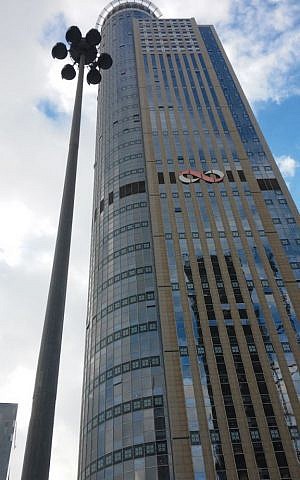
Ramat Gan's Moshe Aviv Tower, Israel's second-tallest edifice, where SpotOption and other binary options companies had offices. (Simona Weinglass/Times of Israel)
SpotOption and its shareholders defrauded American investors from at least April 2012 through August 2017, the SEC alleges in its civil enforcement action. People with knowledge of the company told The Times of Israel that the total amount of money earned past SpotOption through allegedly fraudulent binary options trading is in fact considerably higher than $100 million, and that the SEC has probable specified a effigy it can efficiently prove beyond a reasonable doubt.
Fraudulent binary options companies ostensibly offered customers worldwide a potentially profitable short-term investment. But in reality — through rigged trading platforms, refusal to pay out, and other ruses — these companies fleeced the vast majority of customers out of nigh or all of their money. The fraudulent salespeople routinely concealed where they were located, misrepresented what they were selling, and used false identities.
Israel has not prosecuted any of the thousands of employees of the binary options industry. The U.s. Department of Justice has prosecuted several central individuals, notably including Lee Elbaz, the CEO of Yukom Communications Ltd. who was sentenced to 22 years in prison in 2019. Her bosses, Yossi Herzog and Kobi Cohen, take both been indicted, and are all the same at large.
According to the SEC's complaint, SpotOption served as a one-stop shop for "white label partners" who wished to start a binary options website. These partners straight marketed binary options to investors effectually the world without telling them that they were the counter-parties on all investor trades. In other words, the websites, and SpotOption, made money when investors lost money.
SpotOption provided these white-label partners with everything they needed to starting time a brokerage, the SEC alleges. This included a customized, "user-friendly," website, a content management organisation or "CMS," software that allowed the brokers to create and edit content on their websites; hosting and management of their websites; customer relationship direction or "CRM" software; third-political party payment processing services; also as grooming and other services.
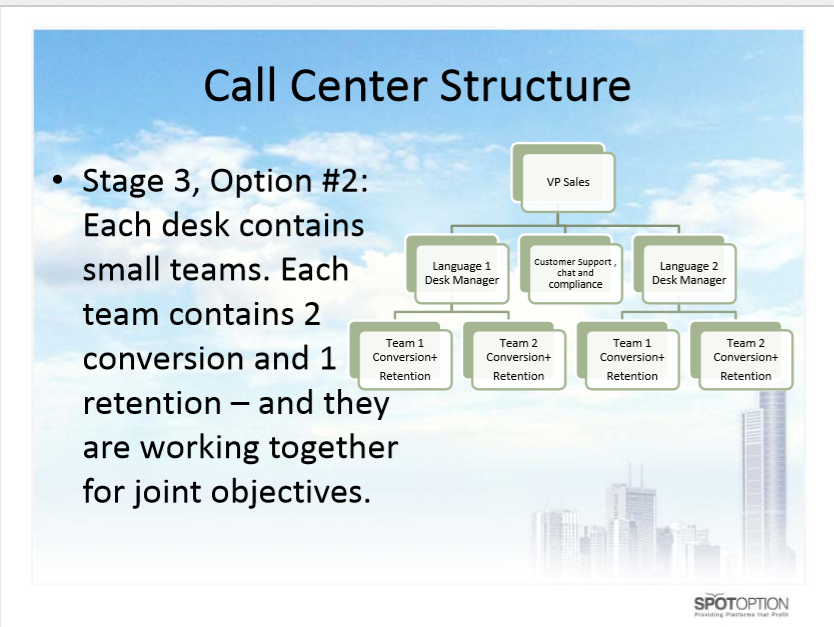
A slide in a presentation that SpotOption fabricated to potential binary options brokers explaining how to fix a call center. (Screenshot)
SpotOption marketed its platform to potential partners past telling them that "the average investor lost 80% of their investment inside five months," the SEC charge alleges.
The SEC further alleges that SpotOption employed "deceptive and manipulative" tactics to cause investors to lose their money and consequently earn coin for SpotOption. These practices included "manipulating the trading platform to increase the probability that trading would be unprofitable" as well equally offering investors a "bonus" that prevented investors from withdrawing their funds.

SpotOption employees in 2016. (Facebook)
Co-ordinate to the SEC, SpotOption targeted thousands of U.s.a. victims, including retirees.
"Many of those investors lost nearly of their money, including, in some cases, hundreds of thousands of dollars meant for retirement. SpotOption and its Partners, on the other paw, raked in millions in profits," the SEC complaint specifies.
"SpotOption's trading platform allegedly supported a worldwide binary options fraud," said Jennifer Southward. Leete, associate director in the SEC's Enforcement Partition, in an April nineteen printing release.
"This action shows that the SEC will work with its strange regulatory partners to pursue international actors who defraud US investors," the SEC'south complaint states.
From Georgia to Kazakhstan to Israel
SpotOption was founded by Malhaz Pinhas Patarkazishvili, also known as Pini Peter, aged 45, an Israeli who was born in Georgia.
In 2005, Patarkazishvili was convicted of fraud, forgery, and money laundering in Israel'south largest-ever bank theft, the Etti Alon Trade Depository financial institution thing. Alon embezzled more NIS 250 meg — $seventy million — and served 14 years in jail. Patarkazishvili, working at a coin irresolute store, Moneynet Allenby, cashed some of the depository financial institution checks that Alon had embezzled.
Patarkazishvili was sentenced to a year in jail for the offenses, unsuccessfully appealed to Israel'due south Supreme Court, but ultimately had his prison term commuted to six months' community service past then-president Shimon Peres.
Subsequently having his sentence commuted, Patarkazishvili became the CEO of a high-tech visitor, EIM Telecom, that had won a lucrative contract to develop a telecommunications network in Kazakhstan. That September, Patarkazishvili was quoted telling State of israel'southward Globes concern daily that the deal, which he had personally signed with Kazakhstan's communications government minister, was expected to bring in $10 meg a year. "This is the offset fourth dimension that an Israeli company is responsible for the overall evolution of an internal and external communications network of a country in Central Asia," he said.
He founded SpotOption in 2009, shortly later he bought a Kazakh gambling automobile company known every bit Vulkan KSI.
SpotOption somewhen expanded to operate hundreds of websites, according to its ain marketing material. These included BigOption, IvoryOption, Lbinary and many others.
1 notable SpotOption make belonged to a Russian binary options company called Trustforex, in which Patarkazishvili's begetter was until recently a business partner with Igor Gorbenko and Boris Spektor.
Gorbenko and Spector are longtime business partners of Yevgeny Prigozhin, who has been sanctioned by the U.s.a. Treasury Department, for operating a troll manufactory that interfered in the 2016 U.s.a. presidential election, as well as for "malign operations in Africa and Europe," according to an Apr 15 press release.
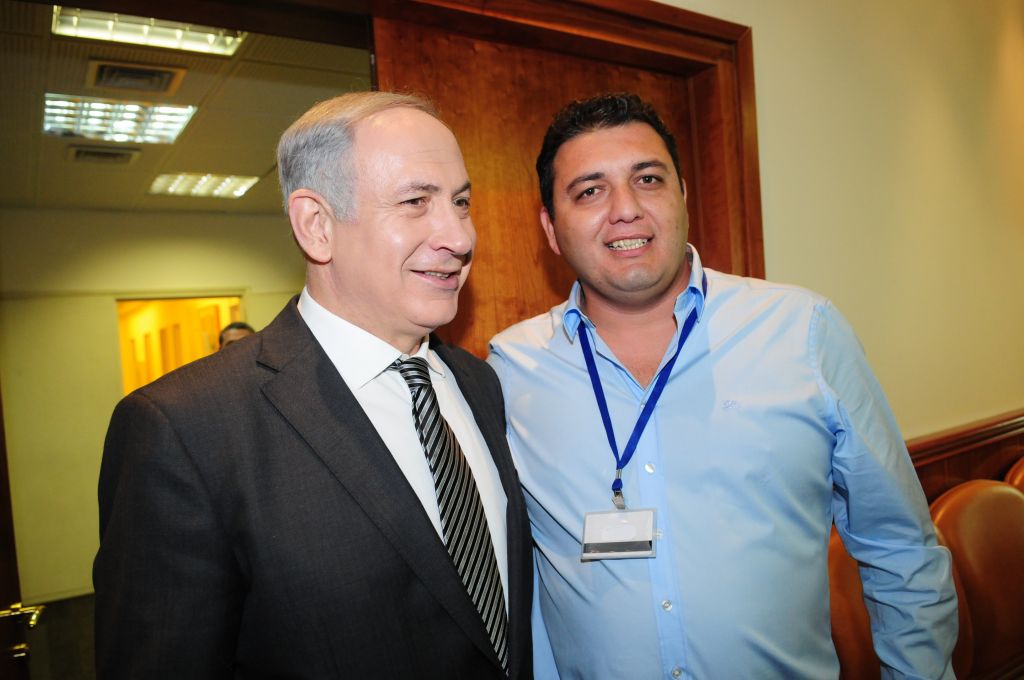
Israeli Prime Government minister Benjamin Netanyahu and SpotOption founder Pini Peter pose together at a charity consequence in the Prime Minister's Office in October 2011. (Berele Sheiner/File)
Pini Peter is a major donor to the Chabad movement, and has oftentimes mingled and met with prominent Israelis in the context of his donations.

Pini Peter at a Chabad event in Cyprus (Facebook)
He has been photographed on numerous occasions with senior Israeli politicians, including Prime Minister Benjamin Netanyahu, Benny Gantz, Gideon Sa'ar, Ron Huldai and others, in that context.

Pini Peter (left) with Gideon Sa'ar and others at an event marking 90 years of the Tel Aviv Great Synagogue in August 2015. (Shalom Lavi)
SpotOption sponsored a ceremony at Tel Aviv's Great Synagogue in 2015 at which new Torah scrolls were dedicated; the scrolls were displayed in front of the SpotOption logo.

A Torah curl anniversary near Tel Aviv's Corking Synagogue sponsored by binary options firm SpotOption, Baronial 24, 2015. (Facebook screenshot)
While Israel's top fiscal regulator was working on the legislation to outlaw all Israeli binary options firms and the Prime Minister'due south Role was urging a worldwide ban on the fraud-blighted manufacture, the Israeli regime secretively gave taxpayers' coin to SpotOption to help it aggrandize abroad, The Times of Israel revealed in 2017.
Government grants totaling some $270,000 were handed out betwixt 2014 and 2016, with the payments continuing even later Israeli regulators banned binary options firms from targeting Israeli customers in March 2016, a twelvemonth before the Knesset banned binary options outright.
The SEC's complaint was filed in federal commune court in Nevada. The investigation was conducted by Deborah Maisel and Jason Anthony.
David Horovitz contributed to this report.

Source: https://www.timesofisrael.com/sec-charges-israels-main-binary-options-firm-and-its-2-chiefs-with-vast-fraud/
Posted by: weyandcortuld.blogspot.com
0 Response to "sec latest binary options news"
Post a Comment